

A Universal Language for Food: How FOODPICT Makes Dietary Diversity Visible
On January 23, 2026, I was invited to speak at the ASEAN Management Training Program held by the Kansai Economic Federation. I had the opportunity to present the FOODPICT initiative to 16 participants from the 10 ASEAN countries. This article introduces the key points of that session.

Hello everyone, and welcome to Japan.
I’m Nobutaka Kikuchi, and the CEO of Foodpict Inc.
It’s a great honor to meet all of you today, and I sincerely appreciate this valuable opportunity to speak with you.
Today, I would like to share the social background behind the growing importance of dietary diversity in Japan, the origin and development of Foodpict, and our initiatives at Expo 2025 Osaka, Kansai.
1. Background and Growing Demand for Dietary Diversity
As cross-border mobility accelerates, Japan welcomed 42.7 million international visitors in 2025, a 15.8% year-on-year increase.
The Japanese government has set a goal of welcoming 60 million international visitors by 2030, meaning that Japan will increasingly host people with diverse cultural backgrounds and values.

In addition, the inscription of “Washoku” as a UNESCO Intangible Cultural Heritage in 2013 has further boosted global interest in Japanese cuisine.
Surveys consistently show that “eating Japanese food” ranks first among what international visitors look forward to before visiting, during their stay, and on future visits.

Food is not only a source of nutrition but also a powerful medium for conveying the identity and appeal of a country and its regions. The Japan Tourism Agency has been promoting gastronomy tourism since 2023, further positioning food as one of Japan’s key growth industries.
With the increase in international visitors and foreign residents, dietary needs have become increasingly diverse. These include people who cannot eat certain foods due to allergies, those who choose not to eat certain foods due to vegetarian or vegan lifestyles, and those who must avoid specific ingredients for religious reasons.

Among the top 15 countries and regions of origin for international visitors to Japan in 2024, 33% come from regions where vegetarianism or Islam represents a significant share of the population. This indicates a growing presence of people with diverse food cultures and dietary practices within Japan.

In surveys asking international visitors about difficulties during their stay, “communication” ranked second, with restaurants cited most frequently as the setting where problems occurred.

Furthermore, surveys of MICE (Meetings, Incentives, Conventions, and Exhibitions) organizers comparing Japan with other countries revealed that, excluding “none,” “meal arrangements responding to dietary diversity” ranked first as the most challenging issue—highlighting Japan’s relative lag in this area.

As dietary diversity expands in Japan, enabling everyone to enjoy meals with peace of mind, regardless of language or culture, requires overcoming three key barriers: language, systems, and understanding.

The language barrier exists because most food packaging and restaurant menus in Japan are written primarily in Japanese. While translation apps have improved accessibility, they remain limited when it comes to accurately conveying ingredient-level information.
The systems barrier stems from differences in laws and cultural frameworks. Japan’s food labeling regulations, governed by the Food Labeling Act, focus primarily on food allergies, while labeling related to vegetarianism or religious dietary restrictions remains underdeveloped.
The understanding barrier arises from limited awareness of diverse food cultures. Insufficient understanding of the variations and personal differences within vegetarian or religious dietary practices can lead to unmet requests or the unintentional serving of prohibited ingredients.

2. FOODPICT: Features and Track Record
As these challenges became increasingly evident, the use of Foodpict, the ingredient pictogram system I developed, began to expand.
Foodpict was conceived while I was studying sustainable development at the University, after participating as a volunteer with the Japan International Cooperation Agency.
While accompanying trainees from around the world, I received a request from a trainee from Saudi Arabia who said, “I would like to try Japanese food.”

However, I was unable to find a restaurant serving Japanese cuisine without pork or alcohol, both prohibited in Islam. In the end, we ate a fish burger together at McDonald’s.
This personal failure in hospitality became the starting point for Foodpict.
As an initial experiment, during a university festival, we collaborated with 80 food stalls and displayed posters indicating the types of meat used and the presence of alcohol in four languages—Japanese, English, Chinese, and Korean—followed by a visitor survey.

While feedback was largely positive, some international students commented that “four languages are not enough.” This insight led to the idea of communicating ingredient information through pictograms rather than words.

In developing Foodpict’s design, we referenced pictogram development guidelines from the International Organization for Standardization, the Japanese Industrial Standards, and Color Universal Design.
We conducted surveys on comprehension, visibility, and required items with over 1,500 participants, including 750 Japanese and 750 non-Japanese respondents. For example, the pictogram for “milk,” relevant to allergies and vegetarianism, underwent significant revisions.

The initial design depicted a traditional farm milk can, but the comprehension rate was only 77%, as respondents from regions without dairy farming traditions could not relate to the image.
We then switched to a milk carton, improving comprehension to 85%, but feedback showed that cartons were unfamiliar in regions where milk is commonly sold in gallon-sized bottles.
Finally, by adopting the classic glass milk bottle, long used worldwide, comprehension reached 98%, resulting in a design that transcends not only language but also cultural differences.
As a business, we license our designs and provide training programs and audit consulting for food service operators, ensuring proper and consistent implementation under a shared set of standards.

To date, Foodpict has been adopted by over 1,600 hotels and restaurants across 100 companies, including international events such as the G20 and G7, as well as major international gateways like Kansai, Narita, and Haneda airports.

In the public sector, Foodpict has been adopted for Evacuee Registration Cards supported by the Japanese government, helping facilitate communication in disaster evacuation shelters nationwide.
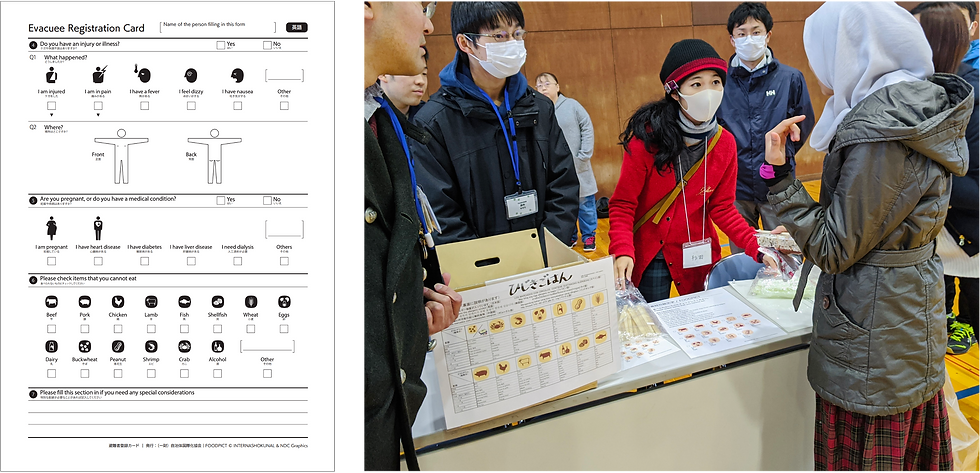
Foodpict has also been introduced in elementary, junior high, and high school textbooks as a best-practice example of inclusive universal design.
3. Expo 2025 Osaka, Kansai: Initiatives and Future Perspectives
At Expo 2025 Osaka, Kansai, held from April to September 2025, FOODPICT Inc. participated as an official operating partner, with support from the Kansai Economic Federation, JTB, YRK& and MUIC kansai, and Foodpict was implemented across the entire venue.

Foodpict was used at over 160 outlets across approximately 80 locations, including around 80% of food service operators, as well as domestic and international pavilions and event venues.It provided peace of mind to 29 million visitors, including 1.77 million international visitors, transcending language and cultural barriers.
Visitors commented that it was “easy to understand at a glance even without knowing Japanese,” while exhibitors noted that “visual pictograms communicate reassurance to international guests” and that they “also support peace of mind for an increasingly diverse workforce.”
The adoption of Foodpict at the Expo encouraged participation by companies that had never previously addressed dietary diversity, serving as a real-world demonstration of the Expo’s theme: “Designing Future Society for Our Lives.”

Following the Expo, momentum has grown among companies to address dietary diversity.
Seven-Eleven, one of Japan’s most well-known convenience store chains, introduced ingredient pictograms for the first time at the Expo. Recognizing their effectiveness, the company has since begun implementing pictogram labeling on its private-brand products.

I believe that the proposal to provide peace of mind through ingredient pictograms achieved meaningful impact as a social message through the Expo.
Looking ahead, I hope to see further adoption by food manufacturers and food service providers, and to expand Foodpict globally as a new international standard for food labeling, originating from Kansai and Japan.
![[Expo Report 1] Gluten-Free Ramen Expands Options for Deliciousness](https://static.wixstatic.com/media/dbf0a5_42760eb017784863a0104425c9e35549~mv2.jpeg/v1/fill/w_980,h_692,al_c,q_85,usm_0.66_1.00_0.01,enc_avif,quality_auto/dbf0a5_42760eb017784863a0104425c9e35549~mv2.jpeg)


コメント